
StudLab for Justice 3.0: Researching Judicial Practice on Money Laundering

A single judgment shows how a court assessed the circumstances of a particular case. Hundreds of judgments reveal recurring approaches, inconsistencies in judicial reasoning, and areas where legal practice still lacks clarity.
This was the focus of the third cycle of StudLab for Justice, where 21 law students from six Ukrainian universities analysed hundreds of court judgments together with eight mentors — detectives from the National Anti-Corruption Bureau of Ukraine (NABU) and prosecutors from the Specialized Anti-Corruption Prosecutor’s Office (SAPO). Their research centred on the application of Article 209 of the Criminal Code of Ukraine, which criminalises money laundering.
StudLab for Justice is the research arm of JustStudents, an initiative that brings together students, practitioners, and institutions to work collaboratively on pressing criminal justice issues. Research topics originate from the needs of the justice system, students investigate them under the guidance of experienced mentors, and the findings return to the professional community in the form of data-driven analysis, conclusions, and practical recommendations.

“It is very important for us to create formats that generate value both for public institutions and for academia. That is why we are especially grateful to NABU for bringing forward this research request and for embracing a new approach within StudLab — from topics developed jointly with mentors to research responding directly to the practical needs of criminal justice professionals. I hope other institutions will follow this example and contribute their own research questions in future cycles. We see this as one of the most promising directions for the development of StudLab,” says Vasylyna Yavorska, CEO of JustGroup.
How the Third Cycle Was Organised
Following a competitive selection process, 24 students joined the programme. Twenty-one participants completed the full cycle, representing Yaroslav Mudryi National Law University, the National University of Kyiv-Mohyla Academy, Ivan Franko National University of Lviv, Lviv State University of Internal Affairs, Taras Shevchenko National University of Kyiv, and the Ukrainian Catholic University.
The first meeting between students and mentors took place on 8 May. Participants formed four research teams, each assigned a separate research topic and supported by two mentors. Over the following two months, the teams analysed court judgments, examined Ukrainian legislation, international standards, and comparative foreign practice, discussed preliminary findings, and prepared analytical reports.
Mentors helped the teams stay focused, test the logic of their arguments, and understand the practical implications of their findings. Responsibility for the research design, conclusions, and recommendations, however, remained entirely with the students.
On 12 August, the teams presented their findings at the High Anti-Corruption Court of Ukraine. The final presentation marked the culmination of several months of work, during which students experienced the full research cycle — from defining research questions and selecting methodology to publicly defending their conclusions.
Why Article 209?
The topic of the third cycle was developed jointly with NABU, responding to the need for a deeper analysis of judicial practice under Article 209 of the Criminal Code of Ukraine.
Legislative amendments introduced in 2019 significantly affected the scope of proof required in money laundering cases, approaches to legal qualification, and the relationship between money laundering and its predicate offence.
At the same time, important questions remain regarding how courts establish the criminal origin of assets, assess the defendant’s knowledge, prove the special purpose of concealing or disguising illicit assets, and apply the autonomous model of prosecution.
The objective of the research was to identify how these issues are reflected in judicial practice and where greater consistency is needed. The teams primarily analysed court judgments issued between 2021 and 2025, while some expanded the dataset to include the most recent judgments from 2026, allowing them to observe developments following legislative amendments.
Beyond Ukrainian case law, participants also examined FATF Recommendations, MONEYVAL assessments, the jurisprudence of the European Court of Human Rights, European Union law, and decisions from foreign courts.
Four Research Directions
Research Track 1. The Objective Element of Article 209 and the Limits of the Autonomous Model
The first team consisted of Diana Yasha, Stanislav Kovtunenko, Anastasiia Bubenchykova, Daria Oliinyk, Maryna Sanchuk, and Veronika Nazarko, under the mentorship of Yelena Drobotova, SAPO prosecutor, and Viktor Yarema, Deputy Head of a NABU Detective Unit.

The team explored the meaning of autonomous criminal liability for money laundering and its relationship with the presumption of innocence.
Their research concluded that the absence of a separate conviction for the predicate offence does not prevent prosecution under Article 209. However, the prosecution must still establish the criminal origin of the assets through sufficient evidence.
The team recommended a clearer distinction between the absence of an identified predicate offence and the failure to prove the criminal origin of assets. Additional recommendations concerned distinguishing acts that complete the predicate offence from independent money laundering transactions, as well as clarifying when possession of property may itself constitute money laundering.
Research Track 2. Establishing the Criminal Origin of Assets: Between the Obvious and the Hidden
The second team included Yuliia Atamanchuk, Anna Perederii, Tetiana Prydalna, Anna-Mariia Levko, and Evelina Aheichenko, mentored by Mykola Karas, Deputy Head of Department at SAPO, and Olha Hrabovska, NABU detective.

Their research examined the factual circumstances courts rely upon when determining the criminal origin of property. The analysis demonstrated that no universal list of indicators exists in judicial practice. Instead, courts reach conclusions by assessing the totality of circumstances surrounding the acquisition, movement, and connection of assets to criminal activity.
The team analysed 51 judgments issued in 2026 (as of 5 June 2026). Thirty-two of them — approximately 63% — were based on plea agreements. In such cases, courts often provide only limited analysis of the evidence establishing the criminal origin of assets, leaving little opportunity for the development of consistent judicial standards.
Among the recommendations were clarifying the statutory definition of criminally obtained property in Article 209, assessing indicators only in combination, and developing methodological guidance for proving money laundering under the autonomous model.
Research Track 3. Knowledge or Assumption? Challenges Related to the Subjective Element of Money Laundering
The third team consisted of Yehor Piekhota, Daria Yarema, Anna Chaika, Sofiia Duka, and Bohdan Yeremeichuk, mentored by Rostyslav Batih, Deputy Head of Department at SAPO, and Daryna Kryvonos, Senior Detective at NABU.

The researchers examined how courts establish a defendant’s knowledge of the criminal origin of assets, assess suspicious financial transactions, consider professional status, and determine the existence of the specific intent to conceal or disguise illicit proceeds. The team analysed 446 court judgments.
Their quantitative analysis revealed a structural weakness in judicial reasoning concerning the subjective element.
- In 70.2% of judgments, the specific purpose of concealment was not analysed separately.
- In 67.4%, courts relied primarily on guilty pleas rather than conducting an independent assessment of evidence.
- In 65.6%, courts failed to distinguish money laundering from related offences or lawful financial transactions.
The researchers recommended abandoning standardised statements that defendants “certainly knew” about the criminal origin of assets and replacing them with individualised assessments of evidence. Professional status, the nature of transactions, relationships between participants, and post-offence conduct should all be analysed together to explain how they support—or fail to support—the existence of criminal intent.
Research Track 4. Standards of Proof in Money Laundering Cases: Between Evidence and Assumptions
The fourth team included Marharita Koroliova, Vlada Mykytchyn, Diana Popovychenko, Oleksandr Pushkar, and Olena Shulepova, mentored by Ivan Diachuk, SAPO prosecutor, and Khrystyna Chaika, NABU detective.

The team analysed international and domestic standards of proof, the role of circumstantial evidence and financial analysis, the limits of the “explain your wealth” approach, and common weaknesses in prosecutorial strategies.
Their findings showed that 96.6% of convictions relied on the derivative model, whereby prosecutors first establish the predicate offence. Only 3.4% followed the autonomous model. More than 56.8% of convictions resulted from plea agreements, making it difficult to assess whether the evidence would withstand a fully adversarial trial.
The team recommended choosing the prosecutorial model early in the investigation, systematically excluding alternative explanations through structured circumstantial evidence, and treating plea agreements as procedural tools rather than substitutes for proper evidentiary analysis.
Evaluation Process
All four reports were submitted to the jury in anonymised and coded form. They were assessed against criteria including analytical quality, methodology and depth, practical value of recommendations, originality, structure, and presentation. Each jury member could award a maximum of 100 points.
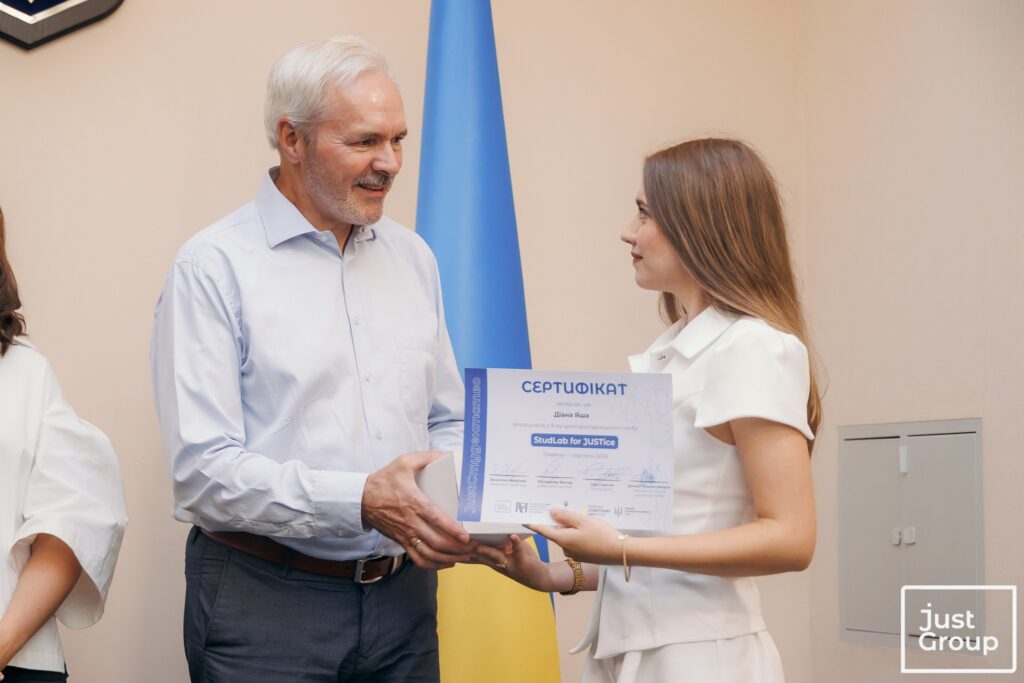
The jury consisted of:
- Mykola Mazur, Judge of the Criminal Cassation Court within the Supreme Court;
- Vira Mykhailenko, Judge of the High Anti-Corruption Court;
- Dmytro Mykhailenko, Deputy Head of the High Anti-Corruption Court and Judge of its Appeals Chamber;
- Mykola Khavroniuk, Professor at the Faculty of Law, NaUKMA and Head of the Criminal Justice Research Centre;
- Marta Yatsynina, Senior Lecturer at the UCU School of Law and Attorney-at-Law.
The highest overall score was awarded to the team researching the subjective element of money laundering. Their paper will soon be published on the JustTalk platform.

“For me, the greatest value of StudLab was the opportunity to explore a topic in depth—one that I hope to work with in my future career. In our case, it was Article 209 of the Criminal Code of Ukraine and money laundering. It allowed us to move beyond a surface-level understanding and truly engage with judicial practice. I am also very grateful to my team for their support, openness, and constant communication. Our mentors deserve special recognition — they helped us stay united, listen to one another, and work towards a common goal. I would encourage every law student to take part in research projects like this and to look for opportunities beyond their own university. These initiatives provide invaluable experience in teamwork, connect students with practitioners, and offer a much deeper understanding of the legal profession,” says Daria Yarema, a member of the winning team of the third StudLab for Justice cycle.
Mentorship as a Shared Search for Answers
Throughout the third cycle, mentorship formed an integral part of the research process. Practitioners helped students refine research questions, consider the realities of law enforcement, and translate observations into practical recommendations. Mentors themselves also benefited from the collaboration.

“First and foremost, I would like to thank the organisers for choosing such a timely topic — the autonomous model of money laundering. We are only beginning to work actively with these cases, so the research aligns perfectly with our practical needs. I am also deeply grateful to the students. They are exceptionally talented, intellectually curious, and already highly professional. Even for experienced practitioners, they offered fresh insights into issues we have dealt with for years. This collaboration was both intellectually rewarding and practically useful. In particular, their observations on structuring circumstantial evidence and improving judicial reasoning have already proven valuable in our own cases,” says Khrystyna Chaika, NABU Detective and mentor.
From Student Research to Systemic Insights
Taken together, the four analytical reports provide a broader picture of how Article 209 is applied in practice.
They highlight the widespread use of plea agreements, limited judicial reasoning regarding certain elements of the offence, the infrequent use of the autonomous model, and the need for clearer approaches to assessing circumstantial evidence, intent, and the specific purpose required for money laundering.


For the students, the programme provided invaluable experience in analysing large datasets of court judgments, developing research methodologies, testing hypotheses, constructing legal arguments, working collaboratively, and publicly presenting their findings.
Most importantly, they experienced how research can respond directly to the needs of practitioners and become a meaningful contribution to professional discussion.
We sincerely thank the Supreme Court and the Kyiv-Mohyla Faculty of Law for their continued partnership in StudLab for Justice; NABU and the High Anti-Corruption Court for initiating the research topic of this third cycle; and Yaroslav Mudryi National Law University, our information partner and principal sponsor supporting these young researchers.
Photo: Anna Putylina
