
From talk to change: how JustGroup supports a new management culture in the criminal justice system

In 2025, JustGroup will continue to systematically invest in the development of management culture among executives and managers in the criminal justice sector. We are convinced that reforms do not start with instructions, but with thinking. That’s why we created the Management Club, a space for reflection, sharing experiences, and finding solutions that meet the challenges of the times.
The meetings of the club are supported by the Faculty of Law of the National University of Kyiv-Mohyla Academy, which provides a platform for inter-institutional dialogue among representatives of the Prosecutor General’s Office, NABU, HACC, the National Police, the Ministry of Justice, and other institutions.

The first meeting of the Management Club in 2025 was held in March and focused on strategic communications in the criminal justice system. Together with Yaryna Kliuchkovska, an expert in strategic and crisis communications, the participants discussed the reputation of law enforcement agencies, crisis messages, and the reasons for deep distrust of institutions. Why does society often perceive the law enforcement system as an “unloved daughter-in-law”? What should be done to avoid losing the communication window of opportunity during changes? Among the main insights is the need to speak with a focus on the needs of the audience, not to report for the sake of reporting, but to demonstrate the value of work through care and consistency.

In April, Club members delved into the topic of personal productivity, a resource without which no effective management system can exist. Together with Sergii Nozdrachov, a KMBS Associate Professor and a certified Gallup expert, they talked about internal drivers, procrastination as an emotional phenomenon, and created a “happiness portfolio” that allows you to manage focus and motivation in your professional life. They discussed why productivity does not start with time management, but with the realization of the value we create, and how utilizing our own strengths affects engagement in work.
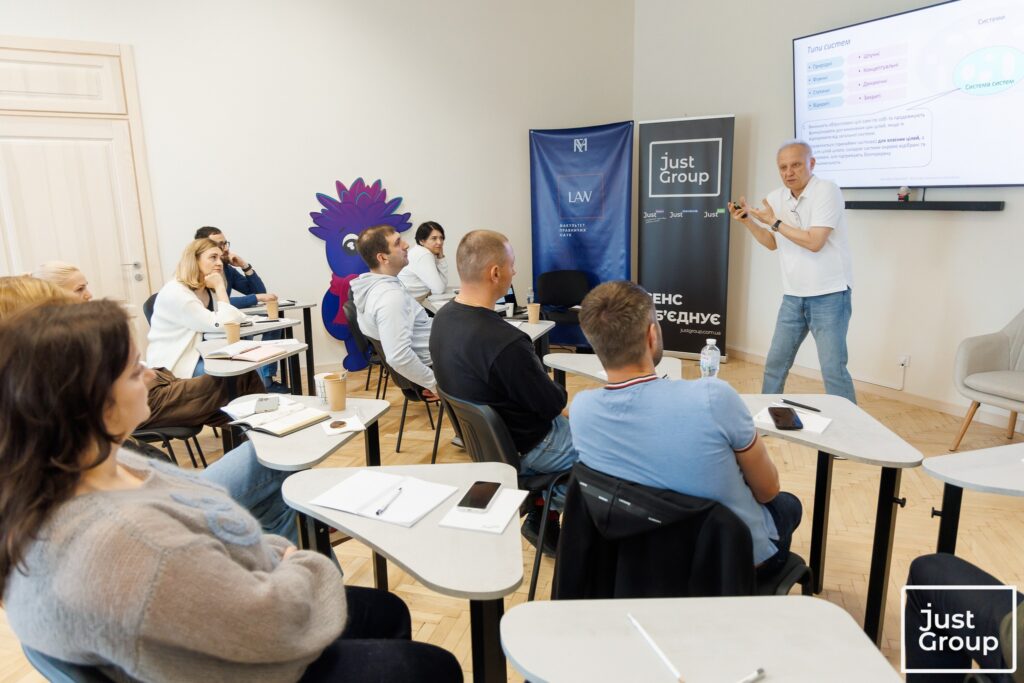
In June, the focus shifted to a deeper topic — systemic thinking in management. Mykhailo Krykunov, Ph.D., Dean of Kyiv Business School and an expert in management thinking, strategies, and leadership, helped the participants to look at the complexity, changes, and problems in criminal justice from a new angle. We analyzed how a network differs from a system, why linear thinking does not work in a complex environment, and how to avoid “knowledge leakage” from institutions. A special emphasis was placed on reflection as a key managerial skill: after all, knowledge can be lost, but meaningful experience can be transferred. This was a logical continuation of the ideas voiced during previous meetings of the Club: from effective communication to deep internal understanding, and up to the vision of the system as a whole.
“Being able to communicate and reflect is an important systemic skill. After all, knowledge is a function of memory, and understanding is a function of reflection.”
— Mykhailo Krykunov

At the October meeting of the Management Club, we discussed what managers need to know and what practical tools help unlock the potential of individuals and teams. After all, this directly affects productivity, loyalty, motivation, endurance, and resilience, and, in general, quality of life. We discussed this with Serhii Nozdrachov:
“For managers, the most important and at the same time most difficult aspect of their work is interacting with people — their role in organizations is constantly growing. At the same time, statistics show that only 23% of employees are truly engaged. This is where the greatest leverage for achieving better results lies. Many leaders understand this, but few manage to change the situation.”
JustGroup continues to develop a space for honest conversation, support, knowledge, and experience exchange among criminal justice managers. We believe that transformation is possible when management practices become deeper, more ethical, and systematic.
Photo: Anna Putylina


