Next Step in Implementation: Evaluating Investigative Interviewing in Ukraine

Mastery is achieved through practice. It is practice that turns knowledge into skill — and in investigative interviewing, this is especially evident.
During a conversation, it is not enough to simply ask the right questions. It is equally important to truly hear the person, to create a safe space for them. This allows for gathering accurate and reliable information. But to genuinely develop these skills, one must not only practice, but also learn to look at themselves from the outside — to see how they ask questions, react, and maintain rapport.
Evaluating to Grow
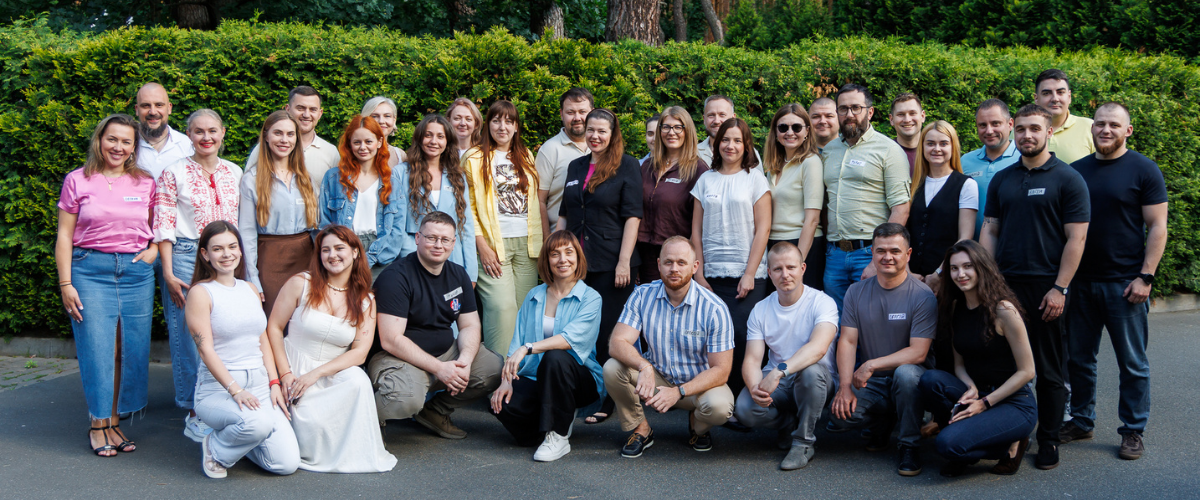
This is why our team of practitioners traveled to Kraków for a workshop on evaluating investigative interviews. This workshop was organised by JustGroup in collaboration with the Norwegian Centre for Human Rights at the University of Oslo and was supported by Norway.
We are grateful to the Norwegian trainers Kjell Erik Eriksen and Sigrid Buset, who worked with us for three days and provided high-quality feedback on the interview videos conducted by Ukrainian practitioners. Kjell Erik has over 30 years of experience in the Norwegian police, most of them as an investigative interviewing instructor. He has trained investigators in Norway, Romania, Estonia, Indonesia, and other countries. Sigrid Buset has many years of experience investigating sexual violence cases and working with children and people in vulnerable situations. She now trains senior investigators and prosecutors in various countries, including Ukraine.

The participants came from a variety of professional backgrounds and faced different challenges. They included prosecutors from the Office of the Prosecutor General and regional prosecutors’ offices, investigators from the National Police, detectives from the National Anti-Corruption Bureau, and Security Service of Ukraine officers who work with war crimes, minors, and suspects in vulnerable states.

Despite the different contexts, all work with people for whom speaking to law enforcement is stressful and requires trust. That is why the workshop focused not only on techniques or interview structure, but also on what happens in the moment — how communication is built and how the interviewer responds. Participants analyzed how tone shifts when a question is asked, how the person across the table reacts, and what actually influences trust during the conversation.


The trainers helped identify what is often overlooked: small signals that shift the tone of the dialogue, or questions that can subtly break rapport. They also taught how to give feedback in a way that helps colleagues understand what exactly could be approached differently. This type of observation requires attention and practice — but this is precisely what professional skill is built from.

Implementing and Researching
For JustGroup and the expert-trainer team on investigative interviewing, it is essential to implement this methodology and research it in order to improve its effectiveness. Five years ago, the study “Tell Me What Happened, or Confess” became the first in-depth analysis of interviewing practices in Ukraine. This study marked the beginning of systematic reforms in how testimony is obtained.
Today, this work moves into a new phase. In addition to workshops, we have launched the study “Monitoring and Evaluation of the Application of Investigative Interviewing in Ukraine”, supported by the International Investigative Interviewing Research Group (iIIRG). Its purpose is to help systematically measure levels of adherence to the methodology, identify strengths and gaps in practice, improve training programs, and build a sustainable culture of humane and effective investigation.
This research is led by a team that has shaped the investigative interviewing approach in Ukraine over recent years — combining scientific analysis, practical experience, and international partnership: Vasylyna Yavorska, Inna Vyshnevska, Viktoriia Rohalska, Viktoriia Livochka, Volodymyr Vasylchuk, Taras Semkiv, Lesia Medynska, and Ivan Dulkai.
The study is implemented in partnership with the Office of the Prosecutor General, the National Anti-Corruption Bureau, the National Police of Ukraine, and the Security Service of Ukraine — institutions that are already applying investigative interviewing in their work.
Systemic transformation of investigative culture is a marathon. And every step we take moves us closer to justice grounded in dignity, evidence, and humanity.
Photo: Anna Petrovska