Immersion in the basics. About the first program to explore the vocation of a lawyer

In our programs, we have repeatedly felt that working with the awareness of the role of a lawyer is often the basis for rethinking the experience and practices of work. The philosophical aspects of the profession are important to stop and reflect on from time to time.
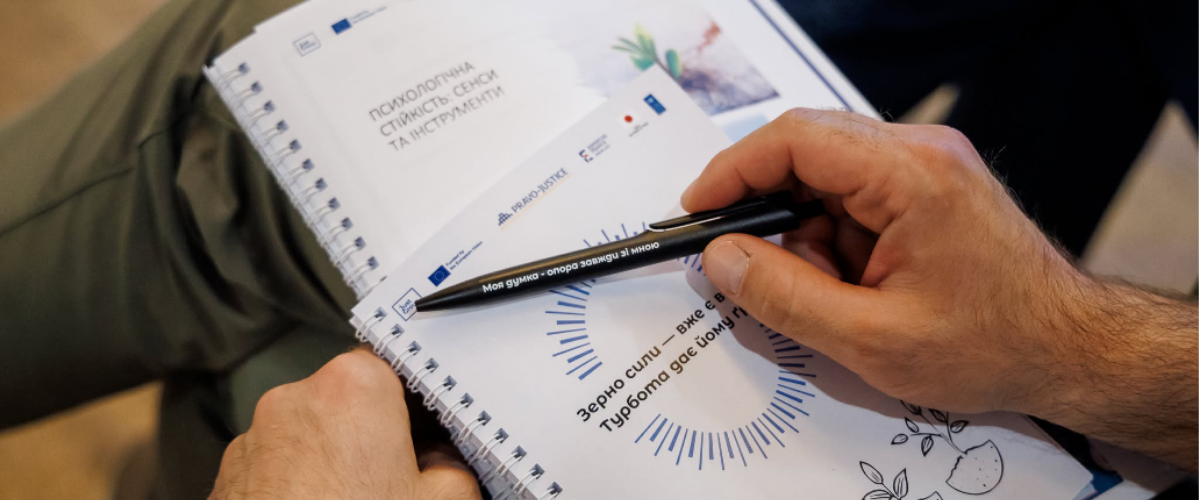
We prepared for this conversation and, together with philosopher Oleksandr Filonenko, designed the first JustLearn program to explore a lawyer’s vocation. The program consisted of four sessions held between June and September 2024.

“The transformation of the system is impossible without the transformation of a person, without cultivating subjectivity and creating spaces where professional communities reflect on what is important. The things that are the core of the profession and determine the behavioral patterns of lawyers,” says Vasylyna Yavorska, leader of the JustGroup team.
Through a competitive selection process, we formed a diverse group of people who were ready to think together, share the challenges of the profession, and strengthen themselves. The 32 participants included judges, prosecutors, investigators, detectives, and lawyers.

“The purpose of a lawyer is to constantly search for answers to questions, and often this path is more important than the goal. This program allows you to ask yourself the right questions, expand your horizons of thinking, and find answers that are not only on the surface of the current legislation but are hidden deeper — in the heritage of all mankind,” shares her impressions Vira Mykhailenko, Head of the High Anti-Corruption Court.
The environment for the formation of legal professionals and the ability of professional communities to be spaces that change themselves and generate transformative ideas is an important prerequisite for deeper transformations at the level of the entire criminal justice system.

“From each meeting, I gained important insights both about myself and about my vocation in the profession. For example, much of what was discussed influenced me to rethink the work on overcoming the consequences of war and the incredibly important role of humanity in these processes, in particular in the daily work of a lawyer. And seeing and studying people who preserve humanity in the face of dehumanization can become a valuable practice. I am also now even more convinced that justice does not equal fairness. And it is a great responsibility of lawyers to understand and accept this,” shares her impressions of the program Daria Svyrydova, lawyer, partner at AZONES.
A significant element of the program was the meeting venues — Ukraine’s formative spaces, such as the Kyiv-Mohyla Academy, Kyiv-Pecherska Lavra, and Saint Sophia Cathedral. They added a special atmosphere and reminded us of the importance of preserving and developing these historical centers as symbols of our cultural heritage.

“For me, the most valuable part of the program was the combination of legal and philosophical components. Philosophical concepts of morality, justice, and humanity have become important tools for analyzing legal practices. This combination allowed me to see how legal decisions can affect human life and society as a whole and realize the importance of ethical principles in legal practice. The opportunity to be in a community of people with values added even more depth to these reflections,” Viacheslav Kolomiichuk, lawyer, Doctor of Philosophy in Law.

Together with the participants, Oleksandr Filonenko studied the works of Hryhorii Skovoroda, Dante, René Girard, and Hannah Arendt. This helped them to understand that a lawyer must uphold not only legal norms but also humanistic values, which are the basis of any law-based society. At the same time, the lawyer’s own vocation should bring beauty, pleasure, and harmony, and meet high moral standards.
“The uniqueness of the program lies in the fact that the question of the ‘vocation of a lawyer’ is approached not through dry formulations and codes, but through works and artistic and philosophical texts that many of our colleagues have either read or will read. It would seem that what could be further than a modern Ukrainian lawyer and the ‘barefoot’ philosopher Skovoroda or the medieval poet Dante? But it turns out that these are all concepts of one line, between which there is only one step — the worldview of a lawyer,” Olesia Dolia from the High Anti-Corruption Court said of the program.
During the last day of the program, Anton Drobovych, Head of the Ukrainian Institute of National Memory, shared his view on models of memory and why different models of memory determine different understandings of justice and its achievement.

We are delighted that there is a demand in the professional community for such in-depth research programs for personal and professional growth. We have already begun to think with a small group of the program about the next steps in vocation research. So, it will continue!