Supporting others, we help ourselves to live. Resilience tips.

We live in times when the words fail to express the pain we feel every day. And, despite everything, we are looking for what and who can help us remain resilient under the avalanche of sad news and continue to do everything in our power at our place.
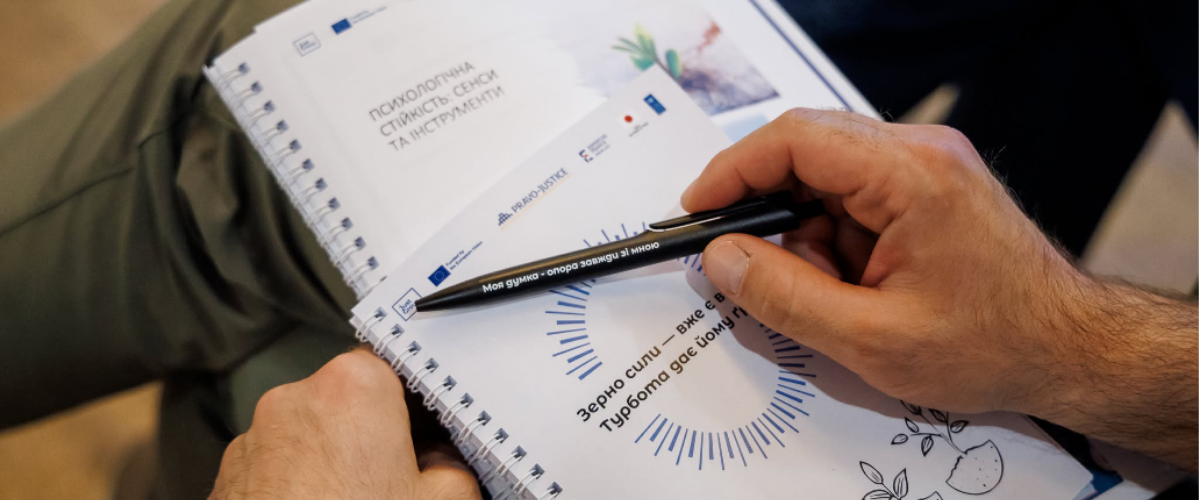
We believe that Resilience team can be such a support in organizations. This is a group of practitioners who, in a peer-to-peer format, help colleagues overcome the psycho-emotional challenges of crises.
In October 2022, JustGroup team has started building a Resilience team based in the Prosecutor-General’s Office, with support from Israel Trauma Coalition and the Training Center for Prosecutors of Ukraine. A group of resilience ambassadors completed the basic training course.
The first interaction of the team members from the Department of Protection of Children’s Rights and Anti-Violence with their colleagues at the workshop demonstrated the importance of creating such a peer-to-peer support space.
The development of personal, team and institutional resilience will continue to be one of the priorities for JustGroup in 2023. We also plan to strengthen the Resilience team with the best Ukrainian and international expertise.
How to talk to people about a psycho-emotional condition?
The resilience ambassadors were recently looking for an answer to this question at a workshop with Anna Metelska, a psychotherapist and a mental health consultant in organizations, co-founder of the Mental Health for Business (MHB) Project.
MHB recommendations from our workshop may be useful for you too.
HOW TO UNDERSTAND THAT A PERSON NEEDS HELP?
Pay attention to significant changes in a person’s behavior or mood (changes in appearance, isolation and withdrawal from communication, sudden changes in mood, emotions do not correspond to the situation, increased aggressiveness, lack of interest in life, lack of desire for anything), increasing difficulties with concentration, attention, fatigue, significant sleep problems, sudden change of environment, alcohol abuse, cynicism in behavior, suicidal thoughts/intentions; jokes about it.
HOW TO SUPPORT OTHERS?
- Understand whether you have enough resources to support another person.
- To be close. In verbal and/or physical contact. Speak. Do not pretend that nothing is happening.
- To be sincerely interested in the person’s condition. Ask: “How are you? Do you want to talk? Is it important for you to talk now?”.
- Offer help: “Do you need my help? What help do you need?”.
- Talk about yourself and your experience: “I recently… I felt yesterday… It helped me…”. Share experiences where appropriate.
- Help the person name the emotion (the person may not be able to identify it). Be supportive by saying, “This is a normal emotion in an abnormal situation.”
- Remember that a person can react in different ways (crying, shouting, wailing, hysterical , silent…), you need to treat this without judgment.
- Show kindness and patience in communication: “I see/feel that you are having a hard time, do you want me to help?”
- Show empathy, not pity.
There is great strength in support. Supporting others, we help ourselves to live and act.