Just_Resilience. How to build a Personal Resilience Code

Practitioners of the criminal justice system who document and investigate war crimes are constantly facing psychologically traumatic experiences and work in an emotionally complex context: they see crime scenes, analyze traumatic videos and other information from open sources, listen to shocking testimonies of victims and witnesses. Investigating war crimes is long-term, it’s a marathon. And this marathon is not only about professional competence, but also about endurance, strength and resilience, about the ability to regulate and restore your psycho-emotional condition. This aspect may not be on the top priority list, but in the long run it is extremely important for successful work.
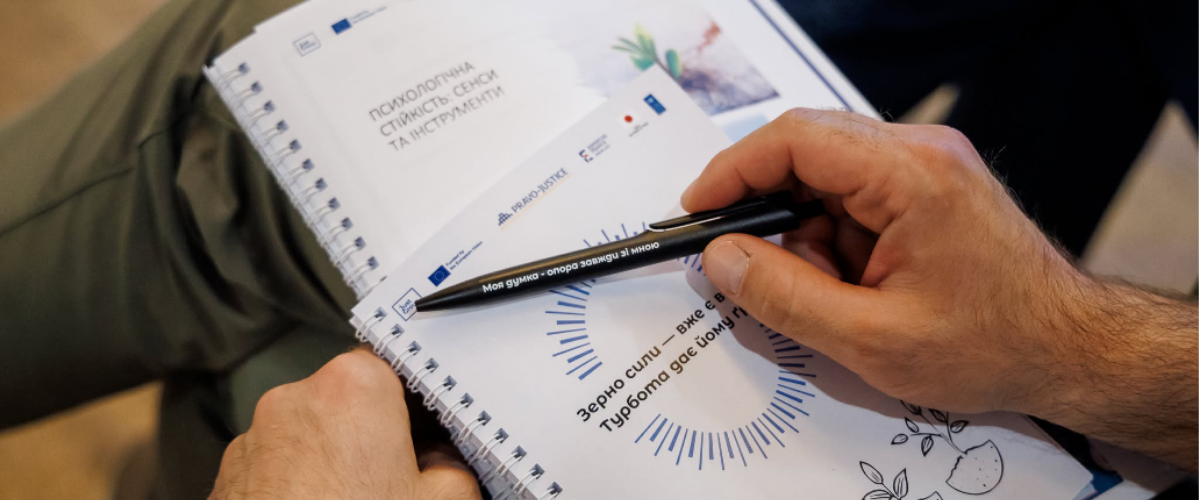
As we are aware of current context and needs, we started working on the design of a program to support and develop resilience in Ukrainian institutions of the criminal justice system together with partners – Israel Trauma Coalition. The first group of practitioners from various institutions has already completed a basic series of webinars.
As a result, we have collected a set of practices that are useful for individuals and teams. It should be noted that an important goal is to establish a systematic and sustainable approach to work with resilience within organizations. This is our next horizon.
Why the experience of Israel?
Israel Trauma Coalition has many years of expertise in working with traumatic experience of war, developing the capacity to act and work in extraordinary conditions, and building personal and organizational resilience.
Crisis psychologist Aleksander Gershanov metaphorically calls Israel a nation which is a laboratory for the development of resilience. The approaches and protocols taught by Israeli specialists have been tested and piloted not only in the research labs, but also in the field – years of wars, hundreds of terrorist attacks and living under terrorist threats. These protocols are used by both the military and the civilian population.
An important feature of Israeli work methods is the use of a salutogenic approach. The salutogenic approach (authored by Aaron Antonovsky) is about working with a healthy part of a person’s psyche, which works as a support for overcoming crisis experiences. Using the right approaches, most people who have experienced traumatic events cope with their consequences and restore their quality of life.
Why is it important to develop resilience for criminal justice practitioners? What is the expert stress?
Expert stress is about our preparation that works in a stressful situation.
In the course of their professional duties, criminal justice practitioners encounter difficult experiences. In such cases, they experience a double psychophysiological burden: they have a natural reaction to stress, but at the same time they must act effectively within the framework of their professional role.
Practitioners with many years of experience develop stress resistance skills and approaches, their own “immunity.” But with the beginning of a full-scale war, the stress factors, their duration and intensity changed.
Our goal is to build necessary skills for the practitioners to be able to reduce the impact of stress reactions, regain a sense of control, and at the same time be as effective as possible in a professional role when they are directly involved in a difficult professional situation.
In a stressful situation, we do not rise to the level of our expectations, we actually fall to the level of our preparation.
So, let’s get prepared!
The system of techniques and approaches is logical and clear. By making a focus on developing resilience, we can quickly develop necessary basic skills.
What approach should be taken to build the Personal Resilience Code (PRC)?
There are no universal techniques and approaches that work equally effectively for everyone. It is better to look at them as Lego blocks which you can use to build your own structure as long as you understand the basic principles.
For the formation and development of the Personal Resilience Code, it is important to use three levels of techniques. They can be a foundation for us to build and train our own working adaptation formula.
Why is it important to use the three types of techniques/approaches?
A crisis is an event that requires us to mobilize, sometimes exceeding the limits of our resources. This is an event that divides our life into “before” and “after,” breaks our continuity of life – former behavioral strategies do not work, functions and roles are lost or changed, the usual view of the world is destroyed. Accordingly, such events require us to adapt more powerfully, because we need to restore the broken continuity of life.
It is the consistent use of three types of techniques that enables us to adaptively overcome crises.
First level techniques
Techniques adapted from army protocols are compact, structured behavioral algorithms. Using them, a person regains a sense of control.
Transition level techniques based on BASIC PH model
Strengthen our stability and ability to function in a crisis situation.
Strategies for adaptive behavior based on BASIC PH
They enable us to use our resource channels and choose ways to adaptively overcome crisis events.
What first line techniques are key?
The basic protocol of self-regulation by Ilon Shapiro The Four Elements can take from 30 seconds to 10 minutes.
The overall goal of the protocol is to regain control as quickly as possible in a stressful situation and turn on the ratio. In each block of the protocol, you will find a recommendation on what to do in or immediately after a stressful situation, as well as advice on how to practice a relevant skill outside of a stressful situation – in a familiar, relatively calm environment. Through training in a routine environment, we learn to respond to stressful situations with different behavior.
Air element
The technique is aimed at working with a change in the rhythm of breathing in a stressful situation. The first important rule in a stressful situation is not to take a deep breath! First we exhale. It is possible to accompany it with sound/voice. Then a normal inhalation and again a full exhalation. You can raise your fist to your mouth and exhale with effort.
TRAINING EXERCISE:
Take a comfortable sit and relax your facial muscles if possible. Exhale completely. Inhale while counting to four. On the count of four, finish inhaling.
Hold your breath for a count of two. Exhale fully again. This exercise must be repeated a maximum of three times so as not to cause hyperventilation.
Water element
The technique is aimed at eliminating dryness in the mouth in a stressful situation. Move your cheeks, stretching them as if in a smile, until saliva is produced.
TRAINING EXERCISE:
Practice this skill in routine situations. In this way, you will train yourself so that in a stressful situation, your body will send a signal to the brain to prevent emotional flooding.
Earth element
The technique is aimed at working with muscle tension, tremors, and the feeling of jelly legs. Pump: raise your shoulders with tension. Then sharply lower them, simultaneously relaxing. Rise up on your tiptoes/toes, tense your calf muscles and come down sharply on your heels.
TRAINING EXERCISE: BUTTERFLY
Take a sit as comfortably as possible. Close your eyes. Place your left hand on your right shoulder and your right hand on your left shoulder. Begin to pat yourself on the shoulders rhythmically, slowly and alternately. The time of this exercise may be from half a minute to two minutes.
Fire element
The technique is aimed at working with tunnel vision (loss of concentration of attention). Make movements with your head, as if your eyes catch large objects around you: windows, a table, a tree, a closet, etc. Fix your vision on them to the left, directly, in front of you, to the right. Then look up and down.
TRAINING EXERCISE:
Look straight. With the help of lateral vision, fix two objects in your field of vision – to the right and to the left. Without turning your head, look right-left, from one object to another, 4 times.
* To move from the Earth technique to the Fire technique (both first line and training), do a massage of the tip of your nose.
Find the sensible part on the tip of the nose and massage with your finger without excessive pressure. It gives a restart effect: the focus is brought back, the vision become clearer.
As you can see, first-line techniques are simple and accessible methods that – if performed correctly and in a timely manner – become an effective mechanism for restoring control in a crisis situation.
What is the model underlying transitional level techniques and adaptive behavior strategies?
Understanding the BASIC PH model is essential for using second and third level techniques and approaches. The multidimensional model of resilience was developed by Professor Mooli (Shmuel) Lahad, who has forty years of experience in working with the consequences of emergency situations and preparing for them.
In the original language, the name of the model means a Bridge that connects – we connect the continuity of our lives broken by crisis events with our behavior, in ways that help us recover. Using certain channels, we update resources that allow us to utilize coping and adaptation strategies as effectively as possible.
The model describes six resource channels. Each and every one of us usually has 1-2 leading channels.
BELIEF – resource channel of the system of beliefs and values
AFFECT – resource channel of feelings and emotions
SOCIAL SUPPORT – resource channel of belonging and social support
IMAGINATION – resource channel of the spirit of creativity and imagination
COGNITION – cognitive resource channel
PHYSIOLOGY – physical resource channel
The answers to the question: “What helps me cope? What distracts me from anxious thoughts?”, as well as self-observation and reflection will provide clues as to which channel(s) are personally resourceful for you. As a rule, a person has 1-2 leading resource channels, and with their help, a person can also connect other resource channels. Resource channels are individual, so what works for one person may not work for another. Therefore, it is important to understand your own channels in order to choose the techniques and approaches that work for you and to expand their range over time.
Each channel has many manifestations and ways of activation.
Below are examples of activities that can help us recover and stabilize, depending on the channels that are the most resourceful for us.
Belief: praying, reading psalms, saying affirmations or phrases that help stabilize/attune, reading motivational quotes or stories about overcoming challenges; horoscopes; amulets
Affect: music, movies, series, fiction, play (for example, with children, pets).
Social support: support, communication with “your” people, communication in the professional community.
Imagination: drawing, crafting, writing practices, rhyming and writing poems.
Cognition: structuring, putting things in order, searching for information.
Physiology: physical activity, body care, comfort and cleanliness, food.
Which channel is your key resource channel?
Through which channel do you turn on the other channels?
What can be the transition level techniques?
Based on the BASIC PH model, it is possible to choose transition level techniques for yourself. You can do it both after the first line techniques and separately.
Transition level techniques are quick and easy actions based on key resource channels that help balance the condition and reduce the impact of stress reactions. By understanding which channels are your key resource channels, you can choose your own individual techniques. Examples of transition techniques based on each channel:
Belief: prayer, meditation, affirmation, touching the amulet
Affect: looking at memes or photos (something that will make you smile)
Social support: writing a reply in a friendly chat, looking around and seeing yourself “among other people”
Imagination: making a paper figure
Cognition: arranging or organizing something
Physiology: moving, walking, smelling things.
Why is it important to know and work with your resource channels?
The more channels we can use, the more adaptive we are. Use your resource channels, look for ways to combine them, experiment and try. Searching is extremely important for adaptability, it also maintains our mental and physical health.
* The material was prepared based on the seminars by Aleksander Gershanov, an Israeli crisis psychologist and trauma therapist, an expert in Israel Trauma Coalition, as part of the JustGruop initiative in partnership with Israel Trauma Coalition.